FEMALE REPRODUCTIVE ANATOMY • 01
OVARIES &
FOLLICLES.
Small structures with an enormous job. The ovaries produce oocytes, support follicular development, and produce hormones that help regulate the bovine reproductive cycle.
START HERE
THE OVARY IS CONSTANTLY CHANGING.
A cow has two ovaries located near the ends of the uterine horns. Although relatively small, the ovaries are central to nearly every part of reproduction.
Throughout the estrous cycle, follicles grow, regress, and sometimes ovulate. Following ovulation, the ovulated follicle transforms into another important ovarian structure — the corpus luteum. Because of this constant activity, the appearance and feel of an ovary can provide valuable clues about where an animal may be in her reproductive cycle.
ANATOMY IN FOCUS
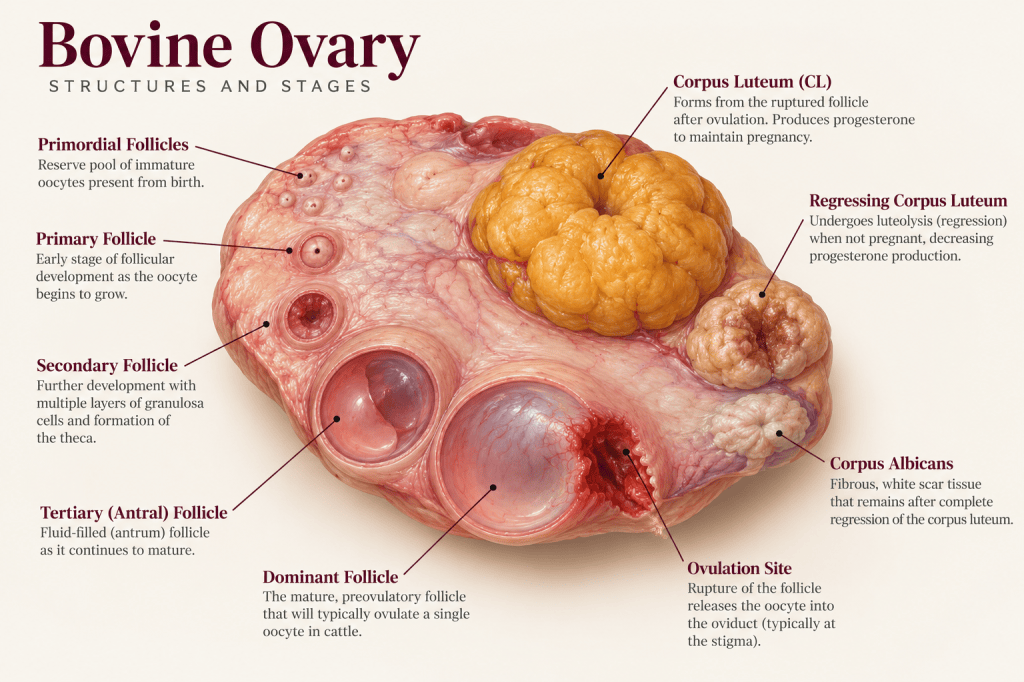
WHAT YOU’RE LOOKING AT.
The ovarian surface can look dramatically different depending on the stage of the cycle. Developing follicles may appear as fluid-filled structures, while a corpus luteum creates a more solid structure following ovulation.
THE ROLE OF THE OVARY
THREE JOBS. ONE CRITICAL ORGAN.
DEVELOP OOCYTES.
Oocytes develop within ovarian follicles. The follicle provides the environment surrounding the developing oocyte as it progresses toward possible ovulation.
PRODUCE HORMONES.
Ovarian structures are major sources of reproductive hormones. Growing follicles produce estrogen, while the corpus luteum becomes an important source of progesterone after ovulation.
RESPOND TO THE CYCLE.
Ovarian structures develop and regress in response to the hormonal signals that coordinate the estrous cycle. What is present on the ovary changes continually throughout that cycle.
FOLLICULAR DEVELOPMENT
NOT EVERY FOLLICLE WILL OVULATE.
Follicles develop in groups commonly described as follicular waves. During a wave, several follicles begin growing, but one typically becomes dominant while the others regress.
Whether a dominant follicle ultimately ovulates depends on the hormonal environment present at that point in the cycle. A dominant follicle can develop without ovulating if progesterone remains elevated.
When the hormonal conditions are appropriate, the preovulatory follicle responds to the signals that lead to ovulation and release of the oocyte.
A SIMPLE WAY TO THINK ABOUT IT
A FOLLICULAR WAVE IN FOUR STEPS.
01
RECRUITMENT
A group of follicles begins developing.
02
SELECTION
One follicle gains a developmental advantage.
03
DOMINANCE
The dominant follicle continues developing while others regress.
04
OVULATION OR REGRESSION
Depending on the hormonal environment, the dominant follicle may ovulate or regress.
THE TURNING POINT
OVULATION CHANGES THE OVARY.
Ovulation is the release of the oocyte from the dominant follicle. After ovulation, the remaining follicular tissue begins reorganizing into the corpus luteum.
IMPORTANT CONNECTION
The follicle and corpus luteum are not unrelated structures. The corpus luteum develops from the tissue of the follicle after that follicle ovulates.
WHY THIS MATTERS
THE OVARY TELLS PART OF THE REPRODUCTIVE STORY.
Understanding ovarian structures helps create context for estrous synchronization, artificial insemination, embryo transfer, IVF, ultrasound findings, and reproductive management. Follicles and luteal structures provide information about what has happened recently and what may be happening next within the reproductive cycle.
KNOW THE LANGUAGE
KEY TERMS.
Oocyte
The female reproductive cell commonly referred to as the egg.
Follicle
A fluid-filled ovarian structure that contains a developing oocyte.
Dominant Follicle
The follicle that continues developing after selection while other follicles within the wave regress.
Ovulation
The release of an oocyte from a mature follicle.
Corpus Luteum
A temporary ovarian structure that develops following ovulation and produces progesterone.
Follicular Wave
A coordinated period of follicular growth in which a group of follicles develops and one typically becomes dominant.
NEXT IN FEMALE REPRODUCTIVE ANATOMY
FOLLICLE & CORPUS LUTEUM →
Repro with Rhianna provides educational information about animal reproduction and management. Rhianna is not a veterinarian, and content on this site should not be considered veterinary advice.

